Move from making decisions on a hunch to making decisions with confidence.
Enterprise Customer
Mugen Taiko
Daihatsu Motor Co., Ltd.
Head of Digital Transformation Group
The limitations we felt in traditional questionnaires and research
Q. What limitations have you felt in questionnaires and research up to now?
When designing a survey, I feel it often starts with a hypothesis and then, in a sense, guides respondents toward that hypothesis—essentially shaping it to obtain the data we want. We may want broad quantitative results like yes/no responses, but that does not let us dig deeply into why things are that way. In the end, additional surveys or interviews become necessary.
When you ask with a hypothesis in mind, the data only reflects that hypothesis, and you end up with results only within the range you had already imagined. I think the inability to go beyond that framework is the limit of traditional surveys.

We could not go beyond the limits of our own assumptions with previous research.
What became visible with Kikuvi: the things we were actually struggling with
Q. What information became visible with Kikuvi that you could not capture before?
The most interesting part is that you can set the initial problem definition and questions, then use the responses to dig deeper with "why, why" follow-up questions. Even before, in one-on-one conversations, we could probe more deeply depending on the interviewer’s skill and interest. But not everyone has the time, people, or budget to do that. The impact of having a tool fill that gap is significant.
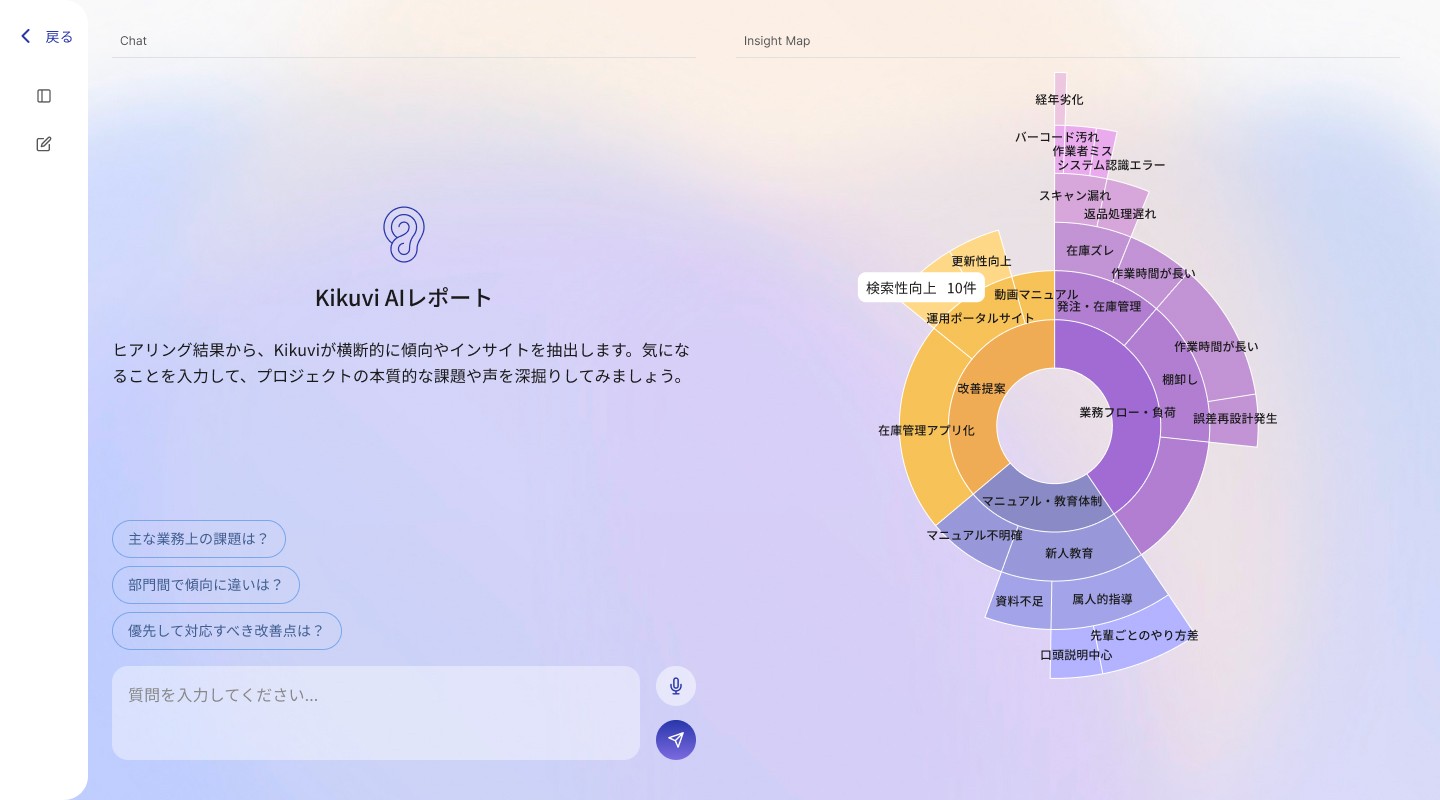
When we asked what people were struggling with in their work, previous survey designs only returned answers within the scope of our hypotheses. With Kikuvi, we can go beyond the hypothesis and reach the point where we realize, "So that was what they were really struggling with." That is the decisive difference, in my view.

It becomes possible to reach the "So that was what they were really struggling with" beyond the scope of the hypothesis.
From "somewhat" to "certain" — improving decision quality and speed
Q. How has the way you make decisions changed?
Because the quality of the answers improves, the quality of the decisions themselves improves. Before, we had to make judgments in a state of uncertainty, only saying "this may be the case." When we have data that has been deeply explored through broad "why why" follow-ups, we can make decisions with supporting evidence, understanding the background as well.
Moreover, the speed of decision-making improves. Since interview time is shortened, unnecessary actions decrease, failures become apparent sooner, and we can move quickly to the next initiative. In this era of advancing AI, where business must move at a fast pace, I feel this is a tool that shifts us from making decisions based on a hunch to making decisions with conviction.

It changes decision-making from being based on a hunch to being based on conviction.
The value Kikuvi brings — replacing the skilled interviewer
Q. In one sentence, why did you choose Kikuvi, and what value does it bring?
In one sentence, it is "a tool that dramatically improves the quality of interviews within the time and resources you have." It replaces the kind of "skilled interviewer" that used to exist only in certain people—time-consuming, dependent on individuals, and difficult to standardize.
In addition, I think there are moments when people can say things to a computer that they would find hard to say to another person. If we can identify common patterns in those voices, we can proactively provide measures and new tools for issues we had not previously noticed. That is what is truly interesting.

People can say things to a device that they would find hard to say to another person. The common patterns that gather there create the next action.
The domain of "questions" — discoveries directly tied to corporate competitiveness
Q. Were there any unexpected discoveries after using Kikuvi?
There is a distinction between a question, an inquiry, and a true question. A question is about eliciting what the other person already knows. An inquiry is about testing something you know that the other person does not. And a "true question" is about posing something neither side knows and drawing out the answer.
With conventional surveys, you can design only up to "questions" or "inquiries." But when you use Kikuvi, AI redesigns the questions based on the other person’s answer, and there are moments when you receive responses you had not thought to ask. That is extremely valuable, and I believe we are moving toward a world where the companies that use it well will become more competitive. That is precisely why I want to make full use of this tool.

Answers come back that neither we nor the respondent knew in advance—that directly leads to strengthening the company’s competitiveness.